

CAD Training Institute
CAD DESIGN
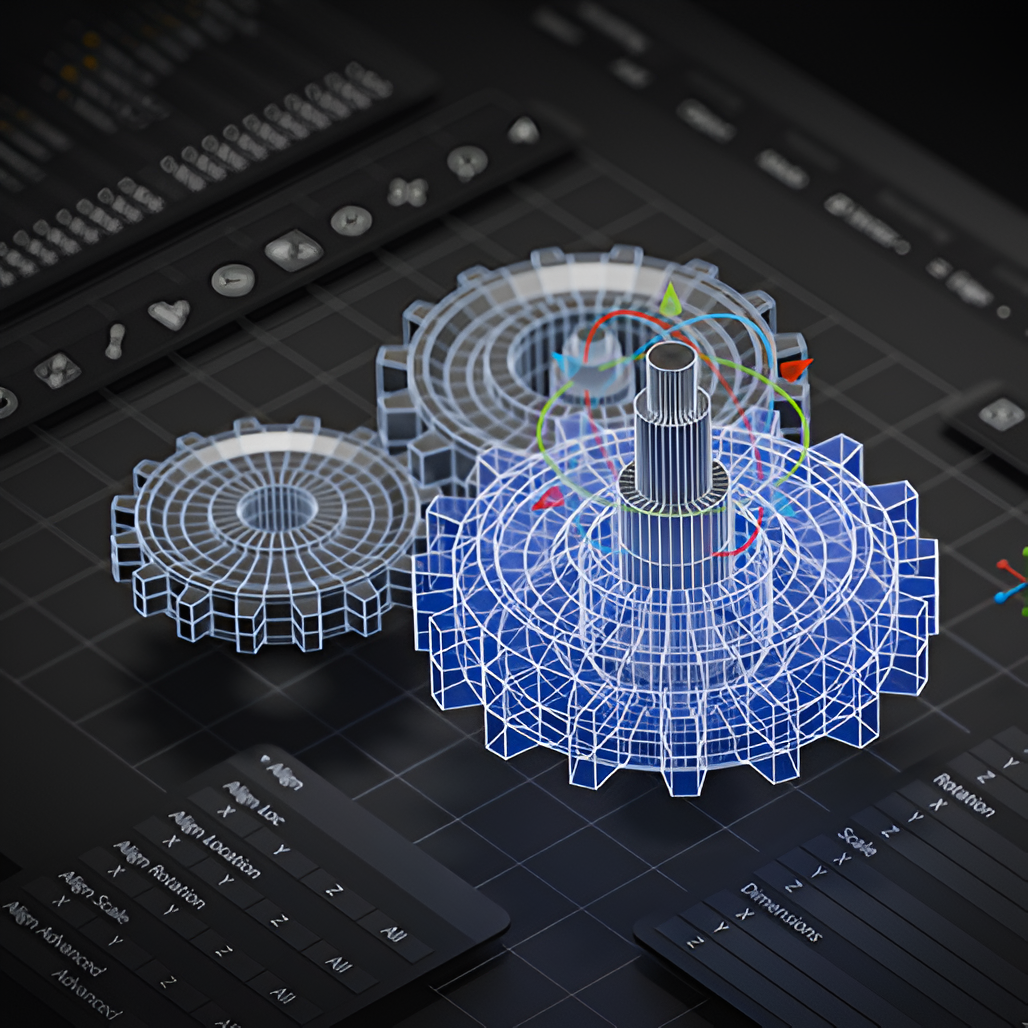
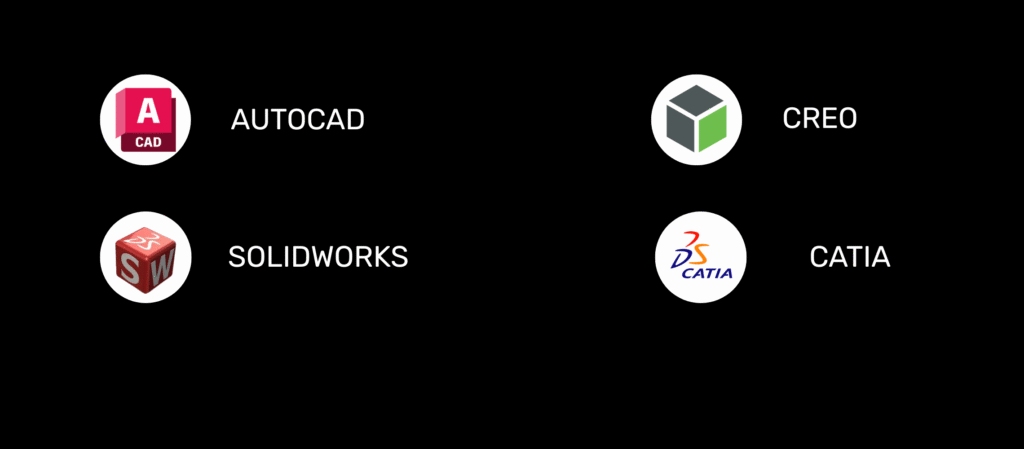
The CAD Design – Multi Software Program is designed to help learners develop strong skills in 2D drafting, 3D modeling, assembly design, and product visualization. The course covers industry-standard CAD tools such as AutoCAD, Creo, CATIA, and SolidWorks, widely used in manufacturing, automotive, aerospace, and product design industries.
Learners gain hands-on experience in engineering drawing creation, parametric 3D modeling, assemblies, and design documentation through practical training.
By the end of the course, students will be able to create professional engineering designs and work confidently with multiple CAD software used in real industrial workflows.
WHY CHOOSE THIS PROGRAM
Industry-focused CAD design curriculum
Covers essential computer-aided design concepts including 2D drafting, 3D modeling, technical drawing, and product design used in modern engineering and manufacturing industries.
Practical learning with real design projects
Work on hands-on design exercises and product modeling tasks to understand how engineering components and mechanical parts are designed in professional environments.
Instructor-led design sessions
Includes guided sessions where instructors demonstrate drafting techniques, 3D modeling workflows, dimensioning, and design best practices.
Hands-on CAD modeling experience
Create technical drawings and 3D models using tools such as AutoCAD, SolidWorks, and other industry-standard CAD software used in engineering design and product development.
CAREERS IN ADVANCED CAD DESIGNING
900K+
jobs in India (2026)
$150B+
global market value
85% Mfg
companies use CAD tools
Up to ₹15 LPA
avg salary
After completing the course, learners can pursue roles such as:
CAD Design Engineer
Mechanical Design Engineer
Drafting Engineer
Product Design Engineer
Junior CAD Engineer
Design & Development Trainee
These roles are available in manufacturing companies, automotive firms, aerospace industries, design consultancies, and R&D organizations.
TRAINING PHASES
Objective: Understand the fundamentals of CAD technology and its industrial applications.
Topics Covered:
What is CAD and its evolution in design automation
Overview of 2D vs 3D design approaches
Types of CAD software and file formats
Importance of design intent, tolerance, and standardization
Hardware & software requirements for CAD design
Outcome: Students understand the CAD workflow and design data management structure.
Objective: Master coordinate-based 2D drawing and modification techniques.
Topics Covered:
User interface, command line, UCS, and drawing units
Drawing tools: Line, Circle, Arc, Rectangle, Polygon, Polyline
Modify tools: Trim, Extend, Fillet, Offset, Move, Mirror, Rotate
Layers, line weights, dimensioning, and hatching
2D projections and orthographic drafting of components
Practice:
Create detailed mechanical part drawings and symbol layouts.
Objective: Build 3D solids and surfaces from 2D sketches.
Topics Covered:
3D workspace setup, UCS manipulation
3D creation tools: Extrude, Revolve, Sweep, Loft
Boolean operations: Union, Subtract, Intersect
3D view manipulation (Orbit, ViewCube)
Generating 2D drawings from 3D solids
Practice:
Model a flange or clamp from 2D geometry and produce 3D projection drawings.
Objective: Learn parametric modeling principles in Creo.
Topics Covered:
Creo interface and sketch environment
Sketch constraints and geometric relations
3D features: Extrude, Revolve, Sweep, Hole, Fillet, Chamfer
Design intent and part regeneration
Practice:
Model individual parts like bushes, pulleys, and brackets.
Objective: Learn to create assemblies and define part relationships.
Topics Covered:
Assembly constraints: Mate, Align, Insert, Offset, Angle
Sub-assembly creation
Hierarchy and assembly management
Exploded view generation
Practice:
Assemble a vice, coupling, or lever mechanism.
Objective: Apply geometric and dimensional constraints accurately.
Topics Covered:
Constraint management in sketches and assemblies
Overconstrained & underconstrained models
Managing relations and parameters for flexible design
Practice:
Modify dimension-driven assemblies and maintain design intent.
Objective: Implement motion mechanisms using joints.
Topics Covered:
Joint types: Revolute, Translational, Cylindrical, Planar
Connection definitions for motion assemblies
Kinematic movement setup and control
Practice:
Simulate lever, piston, or cam motion mechanisms.
Objective: Visualize mechanical motion and analyze performance.
Topics Covered:
Introduction to Creo Mechanism module
Simulation setup: Constraints, drivers, and gravity
Analyzing motion paths and interference
Practice:
Simulate mechanical linkages and study movement limits.
Objective: Generate engineering drawings from 3D parts and assemblies.
Topics Covered:
Drawing creation: Views, dimensions, tolerances
Annotations, BOM generation, and title blocks
Standardization (ISO, ANSI)
Practice:
Create detailed part and assembly drawings for manufacturing.
Objective: Create complex parametric 3D parts using CATIA.
Topics Covered:
CATIA interface and part workbench
Sketcher operations and geometric constraints
Solid creation tools: Pad, Pocket, Shaft, Rib, Groove
Boolean and transformation operations
Practice:
Model 3D mechanical parts such as housings, couplings, or clamps.
Objective: Assemble multiple components into a product structure.
Topics Covered:
Product structure and hierarchy in assembly workbench
Assembly constraints and subassemblies
Exploded view and assembly visualization
Practice:
Assemble a connecting rod, piston, or bearing unit.
Objective: Apply mechanical and geometric constraints for precision assembly.
Topics Covered:
Coincidence, Offset, Contact, Angle, and Fix constraints
Managing constrained systems and dependencies
Practice:
Apply accurate constraints to a gear mechanism or clamp assembly.
Objective: Set up and simulate motion between components.
Topics Covered:
Mechanism workbench overview
Defining joints and links
Assigning motion drivers and control parameters
Practice:
Simulate gear rotations, crank-slider mechanisms, or latch movements.
Objective: Prepare technical drawings and documentation from models.
Topics Covered:
Drafting standards, dimensions, and tolerances
Sectional, auxiliary, and detailed views
BOM creation and title block setup
Practice:
Generate assembly drawings and export PDFs for submission.
Objective: Learn design tree–based solid modeling.
Topics Covered:
Sketch tools and relations
Features: Extrude, Revolve, Sweep, Loft, Hole Wizard
Fillets, Chamfers, Patterns, and Shells
Practice:
Create solid models like brackets, frames, or adapters.
Objective: Build assemblies using mates and subassemblies.
Topics Covered:
Mates: Coincident, Parallel, Tangent, Gear, and Rack Pinion
Assembly hierarchy and motion setup
Exploded view and animation setup
Practice:
Assemble a gearbox or machine vise and animate motion.
Objective: Define and control mechanical relations for assembly precision.
Topics Covered:
Constraint management, alignment, and interference checks
Advanced mates and relation-driven assemblies
Practice:
Adjust constrained assemblies and verify alignment accuracy.
Objective: Apply and simulate realistic mechanical motion.
Topics Covered:
Revolute, prismatic, and universal joints
Gear and cam motion setup
Time-based motion study configuration
Practice:
Simulate a 4-bar linkage or gear-driven system.
Objective: Produce industry-standard drawings and documentation.
Topics Covered:
View creation, dimensioning, and notes
Bill of Materials generation
Title block customization and sheet formats
Practice:
Prepare complete part and assembly drawings for production.
Objective: Learn naming conventions, revision control, and CAD data management.
Topics Covered:
Versioning and file referencing
Interoperability (STEP, IGES, DWG, STL)
Document templates and design data security
Practice:
Organize design files using proper versioning and part numbers.
Objective: Combine all CAD skills into one multi-software project.
Project Scope:
AutoCAD → Base 2D layout
Creo / CATIA → 3D modeling and assembly
SolidWorks → Motion simulation and rendering
Deliverables:2D & 3D drawings
Simulation video/screenshots
Project report and design presentation
MASTER IN-DEMAND CAD DESIGN TOOLS
CAREER SUPPORT

1:1 mentorship from industry experts
Get 1:1 career mentorship from our industry experts to prepare for jobs in AI and ML

Interview prep with experts
Participate in mock interviews and access our tips & hacks on the latest interview questions of top companies

Resume & profile review
Get your resume/cv and LinkedIn profile reviewed by our experts to highlight your AI & ML skills & projects

Access to RagatechSource Job Board
Apply directly to top opportunities from leading companies with our Job Board
DURATION
Course Duration: 4 Months
Class Duration: Up to 8 hours per day
Includes: Recorded sessions, software tutorials, and project guidance
WHO CAN JOIN
This program, offered by Raga Tech Source, a trusted CAD Training Institute, is designed for learners who want to build strong design fundamentals and gain practical exposure to industry-standard CAD tools. The CAD course focuses on real engineering workflows used in design, R&D, and manufacturing environments.
This course is a good fit if you are:
- A diploma or engineering student aiming to start a career in design or drafting
- A mechanical or production engineering trainee looking to strengthen CAD skills
- A beginner interested in learning multiple CAD software tools from the ground up
- A professional seeking hands-on CAD exposure for design or manufacturing roles
However, this course may not be suitable if you are looking for theory-only learning without software practice or expecting non-engineering design training. Learning at our CAD center emphasizes practical application, multi-software exposure, and industry-aligned design practices.
Frequently Asked Questions (FAQs)
This CAD course covers 2D drafting, 3D modeling, assemblies, detailing, and product visualization using tools such as AutoCAD, Creo, CATIA, and SolidWorks.
The program is suitable for diploma holders, engineering students, fresh graduates, and professionals aiming to work in design, R&D, or manufacturing environments
No prior CAD experience is required. The training provided by our CAD Training Institute starts from the basics and gradually progresses to advanced design concepts.
The training is primarily practical, with hands-on exercises, real engineering examples, and guided lab sessions.
Learners are trained on industry-standard CAD tools including AutoCAD, Creo, CATIA, and SolidWorks.
Yes. Learners receive a course completion certificate from Raga Tech Source after successfully completing the program.
Yes. The course structure supports working professionals through structured sessions, practice-based learning, and revision support.
Raga Tech Source, a dedicated CAD center, focuses on practical, multi-software training aligned with real engineering workflows and industry requirements.